








Why Your Enterprise AI is Stuck in "Advisory Mode" (And How ServiceNow's New Real-Time Data Stack Fixes It)
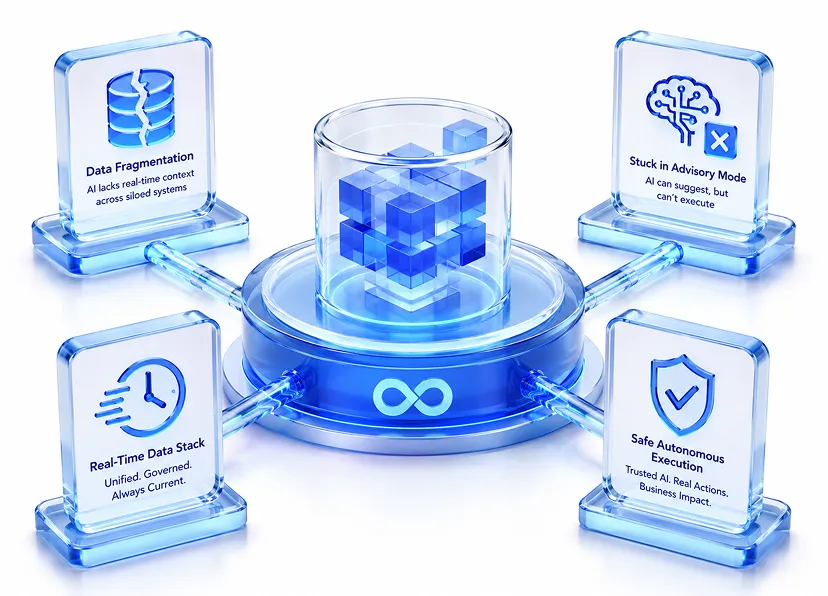
Most enterprise Artificial Intelligence projects initiated over the last few years are suffering from a common, frustrating limitation: they can suggest things, but they cannot execute them. Your generative AI tools can draft emails or summarize long PDFs, but they stall the moment they need to autonomously reallocate a cloud budget, change a manufacturing route, or update an active security posture.
This isn't a problem with the AI models themselves. It is a data fragmentation issue. When AI agents lack real-time context and are forced to operate across siloed, inconsistently cataloged systems, they cannot be trusted to act autonomously.
At Knowledge 2026, ServiceNow (NYSE: NOW) addressed this bottleneck by launching an enterprise-grade, real-time data foundation explicitly designed to transition organizations from advisory AI to true autonomous execution.
At Toptech, we recognize this as a massive architectural turning point. ServiceNow is asserting itself as the centralized operational engine where insight meets transaction. Here is our strategic breakdown of ServiceNow’s new data stack and how C-suites can leverage it to safely unlock autonomous operations.
The Core Blueprint: Giving Autonomous AI Institutional Memory
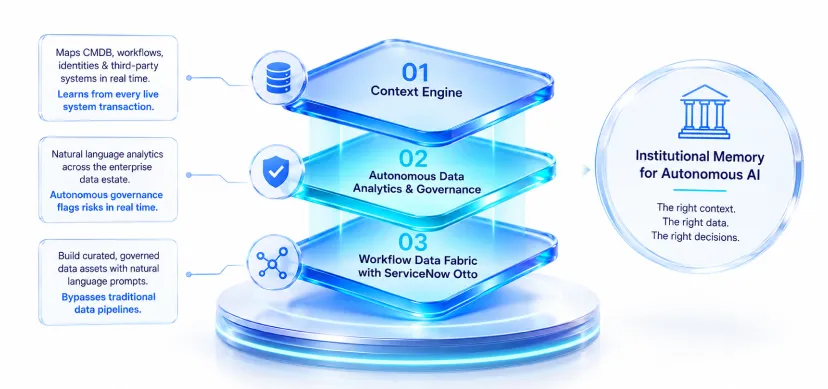
To make a high-consequence decision safely, an AI agent needs the same institutional context as your best human employee. It needs to know who people are, what assets they own, what corporate policies apply, and how processes have historically executed.
ServiceNow’s new release introduces three interconnected layers to construct this "context engine":
- The Context Engine: This acts as a semantic layer mapping your configuration management database (CMDB), historical workflow patterns, user identities, and third-party systems in real time. Instead of pulling cold data from a warehouse, the AI continuously learns from every live system transaction.
- Autonomous Data Analytics & Governance: Leveraging capabilities from the recent acquisition of Pyramid Analytics, users and AI agents can query the entire enterprise data estate using natural language. Crucially, the platform introduces Autonomous Data Governance—an automated layer that flags data quality and privacy policy violations in real-time, preventing toxic or unverified data from feeding your models.
- Workflow Data Fabric with ServiceNow Otto: This interface allows business units to build curated, highly governed data assets through simple natural language prompts, bypassing traditional, heavily bottlenecked data-engineering pipelines.
Eliminating the Data Copy Tax: The RaptorDB Pro Evolution
For years, the hidden drain on IT budgets has been the "data copy tax"—the endless building of ETL (Extract, Transform, Load) pipelines to replicate live operational data into analytical warehouses so business intelligence (BI) tools could read it.
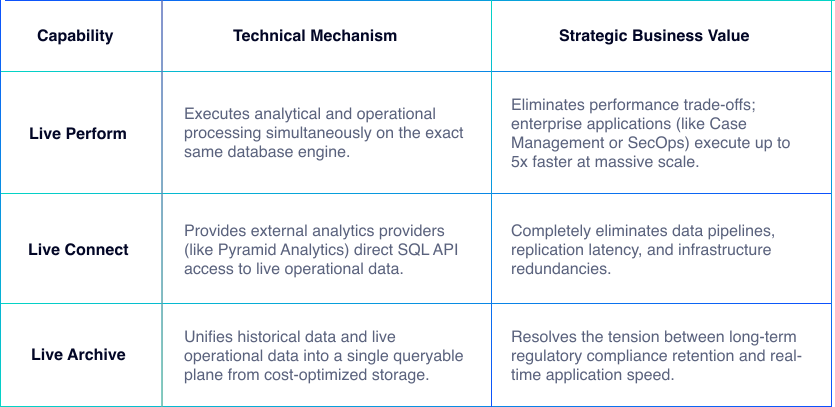
To power agentic workloads that demand split-second data access, ServiceNow has significantly upgraded its native high-performance database, RaptorDB Pro, through three new capabilities:
RaptorDB Pro Architectural Framework
Furthermore, RaptorDB Pro now includes native support for multi-modal processing of graph and time-series data. If your enterprise operates across complex infrastructure networks, manufacturing environments, or healthcare environments, this allows your autonomous agents to model complex dependencies and predict system failures before they impact production.
Fixing the Agent Security Void: The MCP Registry
As enterprises rush to adopt agentic workflows, an alarming governance gap has emerged. Teams are connecting autonomous AI agents to external tools, third-party applications, and public servers with absolutely no centralized audit trails or security access controls.
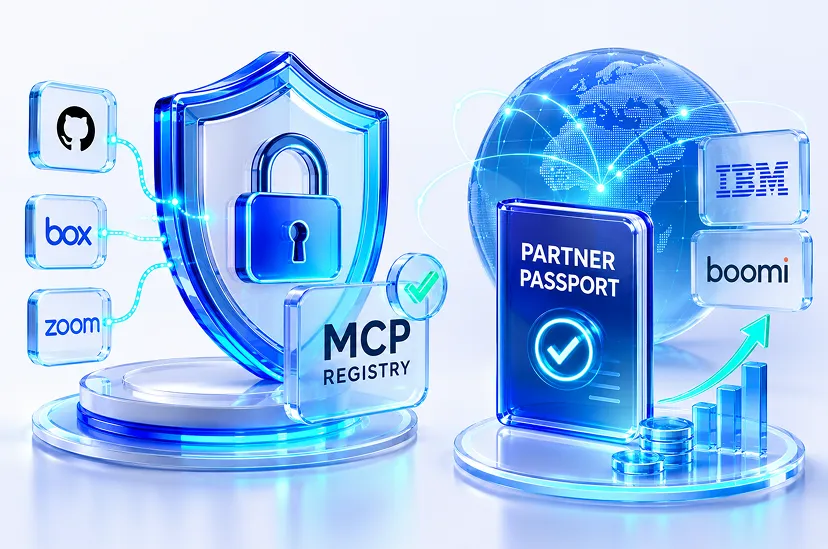
ServiceNow has introduced the MCP (Model Context Protocol) Registry to solve this. Built on open-source API standards and managed through the ServiceNow AI Control Tower, the MCP Registry serves as a private, vetted enterprise catalog of approved external servers (with early partners including GitHub, Box, and Zoom).
Instead of letting an AI agent freely ping external data sources, the agent can only discover and connect to systems explicitly greenlit by your security team. This brings AI agent behavior under the exact same compliance rigor applied to human employees.
The "Partner Passport" Financial Shift
Procurement and financial officers should take note of the new Workflow Data Network Partner Passport. Launching in the second half of 2026, this commercial framework allows your organization to use existing ServiceNow Data Fabric credits to activate and consume third-party data solutions (starting with IBM and Boomi). This allows you to consolidate your data quality, observability, and workflow spend under a single, highly leveraged commercial agreement, maximizing your platform ROI.
Preparing Your Data Architecture
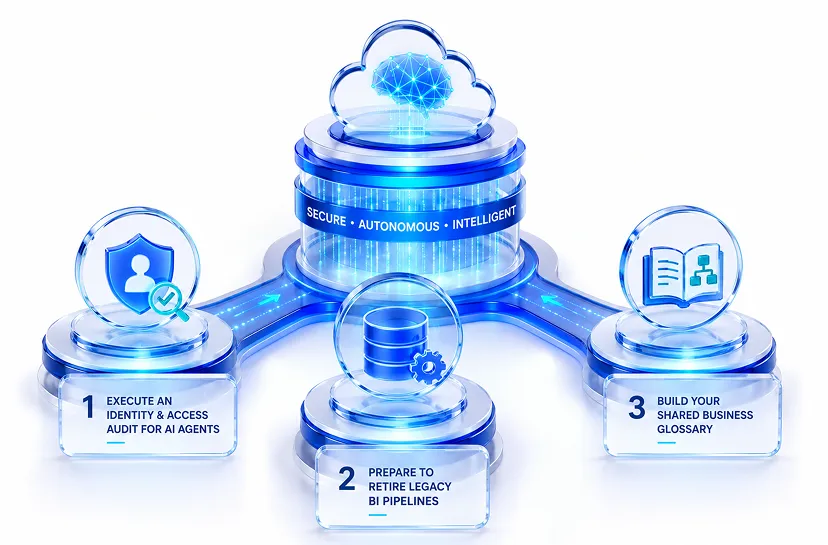
Moving your organization into a state of secure, autonomous AI operation requires localized tactical prep. Our senior consultants at Toptech recommend three immediate steps:
- Execute an Identity and Access Audit for AI Agents: Before deploying autonomous agents against the new Context Engine, define your AI access tier profiles. Use the new AI Gateway to establish real-time observability over what data your agents are querying. An agent should never possess broader system access privileges than the human users it is acting on behalf of.
- Prepare to Retire Legacy BI Pipelines With RaptorDB Pro’s Live Connect and Live Perform now active, audit your current data warehouse architecture. Identify legacy ETL pipelines that exist solely to sync ServiceNow operational data out to external BI platforms. By switching to live direct querying, you can drastically reduce data latency and cut storage costs simultaneously.
- Build Your Shared Business Glossary Leverage the ServiceNow Data Catalog to establish end-to-end lineage tracking and a shared business glossary across your disconnected applications. Autonomous Data Governance cannot enforce data quality rules if your business logic remains unmapped or inconsistently defined across departments.
Autonomous AI cannot operate effectively on fragmented, stagnant data. By integrating a live semantic context engine, a unified operational/analytical database, and strict agent protocol governance into a single platform, ServiceNow has created the foundational control tower required for secure enterprise automation.
At Toptech, we help enterprises architect this modern data fabric, ensuring your transition to autonomous AI is fast, profitable, and secure.