








Bridging the AI "Completion Gap": Why ServiceNow Otto is the New Front Door for Enterprise Operations
The corporate world has a hidden AI friction point. Over the past few years, enterprises have aggressively adopted large language models and point-solution chat tools. Yet, despite staggering investments, true efficiency remains elusive.
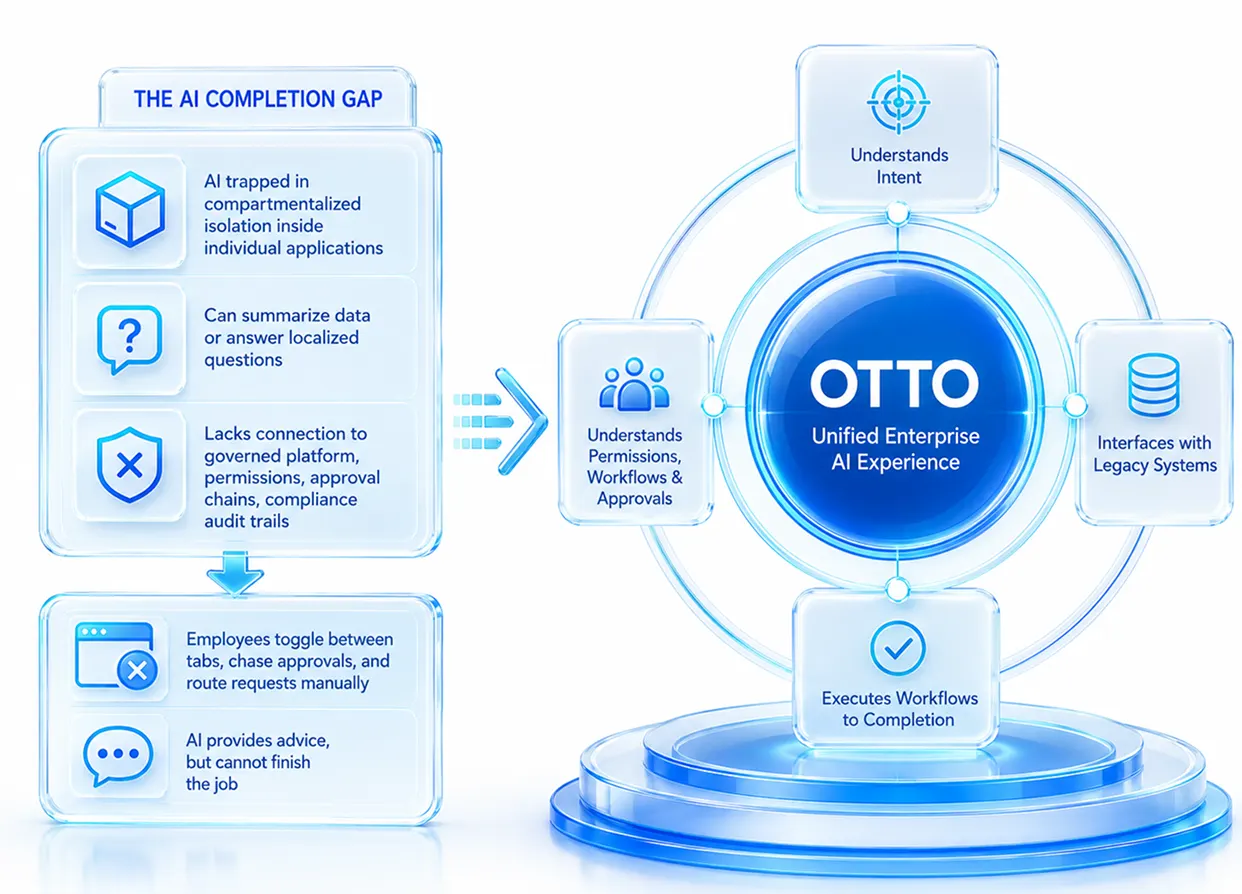
The issue is what industry experts call the AI completion gap. Most conversational AI layers are trapped in compartmentalized isolation inside individual applications. They can summarize data or answer localized questions, but they lack connection to a governed platform. They do not understand cross-departmental workflows, corporate permission levels, approval chains, or compliance audit trails.
As a result, employees still find themselves toggling between a dozen open browser tabs, chasing manual approvals, and routing their own requests. The AI provides advice, but it cannot finish the job.
At Knowledge 2026, ServiceNow (NYSE: NOW) launched its definitive structural remedy: ServiceNow Otto. Synthesizing the underlying intelligence of Now Assist, Moveworks, and advanced platform experience layers, Otto acts as a unified enterprise AI experience. Instead of forcing employees to navigate the underlying software infrastructure, Otto understands intent, interfaces with your legacy systems, and executes workflows to full completion.
At Toptech, we look past the marketing headlines to analyze what this means for your tech stack architecture and operational strategy. Here is our executive breakdown.
Technical Architecture: One Interface, Absolute Orchestration
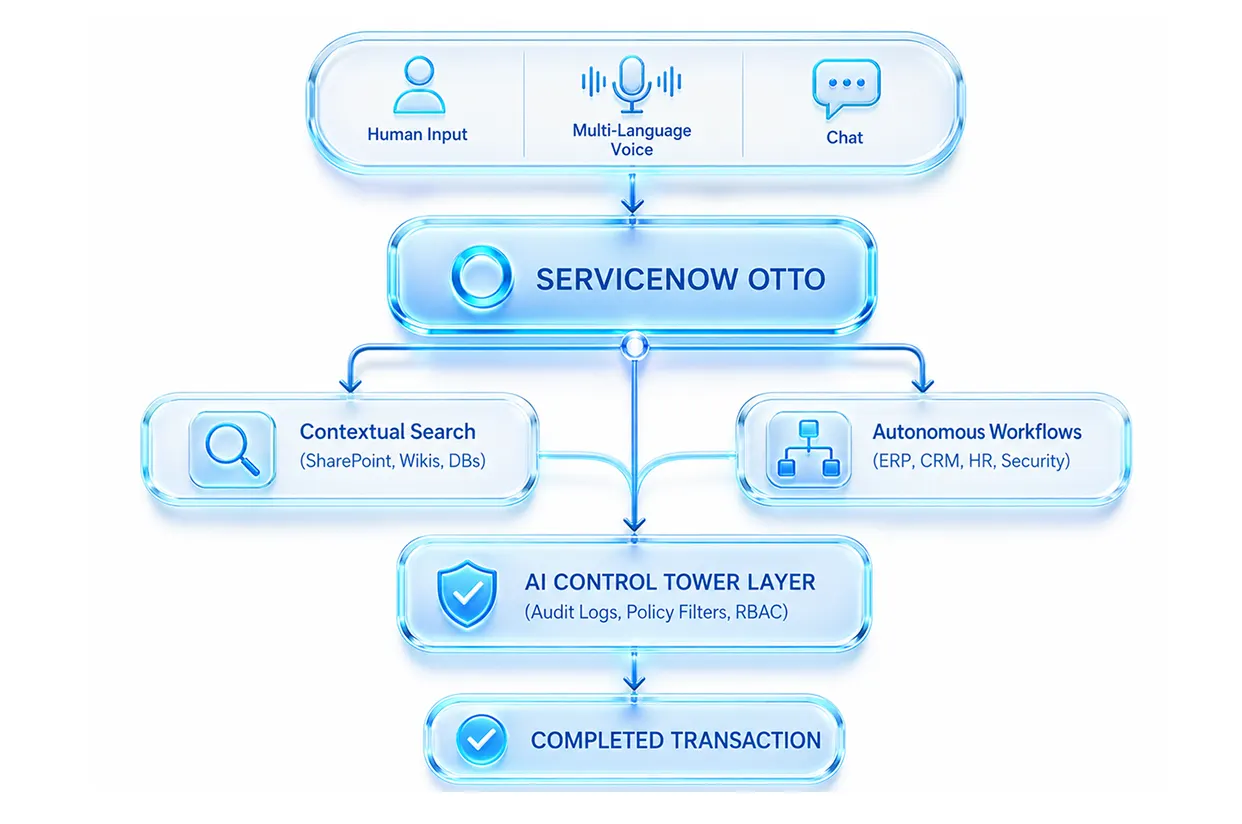
What makes this release functionally distinct from a standard chatbot plug-in? ServiceNow Otto does not live inside a single module or application scope. It sits across the entire enterprise ecosystem, acting as a conversational, multi-modal layer that translates natural human language into structured, multi-system transactions.
The system operates through four primary functional lenses:
- Conversational AI Intent Routing: Employees submit requests in plain language. Otto automatically assesses whether the request belongs to HR, IT, legal, or finance, triggering the correct backend workflow without the user ever interacting with a portal or filling out a form.
- Unified Enterprise Search: Rather than searching within siloed databases, Otto dynamically indexes and searches across your entire data estate—including local wiki pages, enterprise databases, and Microsoft SharePoint—delivering a single, personalized answer tailored to the user's specific corporate role, geography, and department.
- Multilingual AI Voice Agents: Moving beyond frustrating, rigid telephone menu trees and hold queues, Otto handles direct oral phone requests through interactive, natural language voice conversations in multiple languages simultaneously.
- AI Data Explorer: Allowing business leads and analysts to query deep, underlying platform datasets using conversational sentences to generate real-time metrics, predictive analysis, and visual data breakdowns instantly.
The Power of Grounded Governance
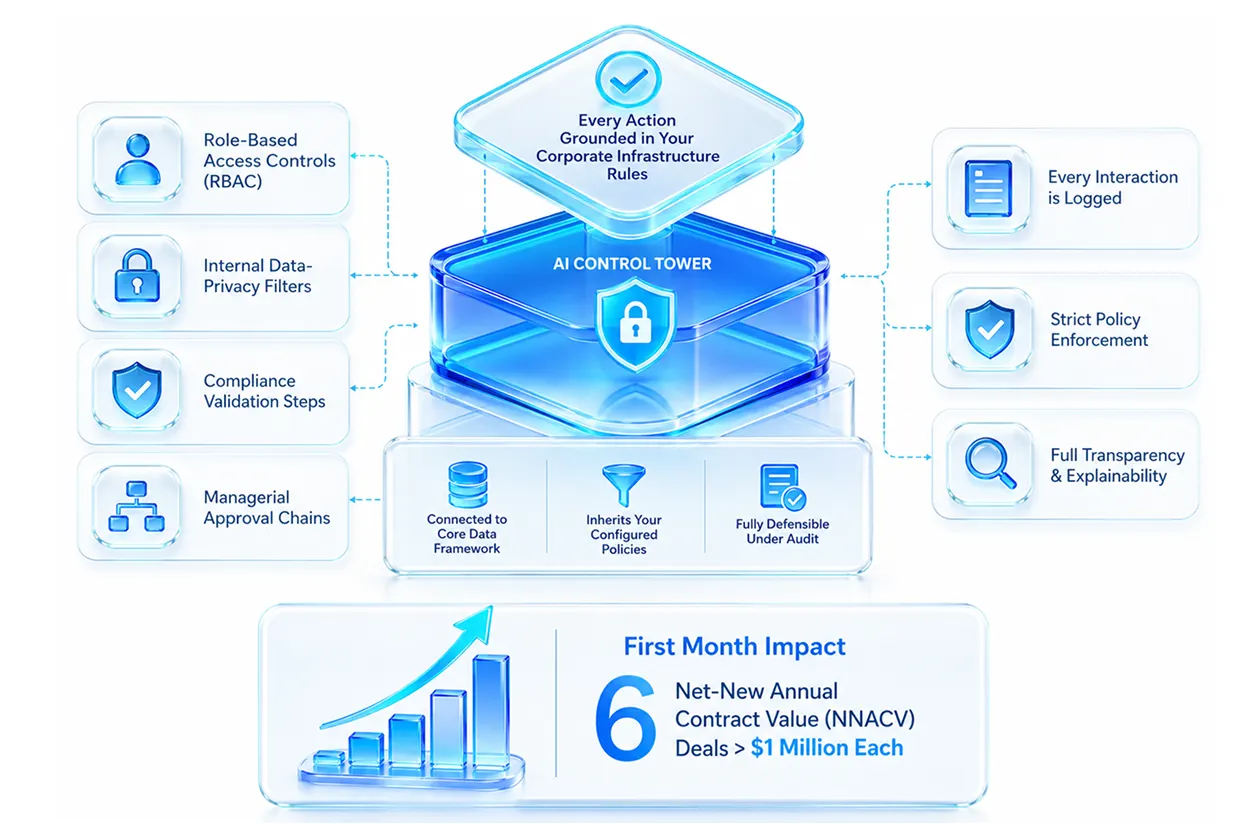
The ultimate value proposition of this framework is that Otto does not execute actions blindly. Every transaction, query, and workflow routing performed by the agent is strictly anchored within your corporate infrastructure rules via the AI Control Tower.
Because Otto is directly connected to the platform’s core data framework, every action inherits your pre-configured role-based access controls (RBAC), internal data-privacy filters, compliance validation steps, and managerial approval chains. The AI Control Tower logs every interaction, ensures strict policy enforcement, and offers full transparency and explainability for every automated decision—meaning your AI operations are fully defensible under audit.
The financial validation of this architecture is already visible. In the first month after its initial deployment within the ServiceNow EmployeeWorks suite, the solution generated six net-new annual contract value (NNACV) deals exceeding $1 million each. When an AI tool moves past basic advice and successfully executes actual, complex work safely, enterprise adoption follows exponentially.
Preparing Your Operations for Unified AI
Transitioning your corporate service interface away from legacy ticketing portals and moving toward a conversational front door requires intentional platform design. Our enterprise architects at Toptech recommend focusing on three core initiatives:
Consolidate Your Knowledge Repositories
Because ServiceNow Otto utilizes enterprise search to pull information dynamically out of sources like SharePoint, corporate wikis, and file databases, its answers are entirely dependent on the cleanliness of your data. Prioritize a data-cleansing campaign to archive outdated policy documents, resolve conflicting internal instructions, and unify disparate knowledge bases before rolling out the search layer.
Map Cross-Departmental Workflows End-to-End
Otto excels at resolving multi-system requests headlessly (e.g., an onboarding request that requires an HR record update, a procurement hardware order, and an IT software provision). However, the AI cannot execute what is not defined. Work with your departmental leads to explicitly map out and clean your cross-functional APIs and handoff thresholds.
Move from Navigational Training to Intent Optimizations
Stop spending corporate training budgets teaching your employees how to navigate complex, multi-tiered software portals. Instead, pivot your internal change management strategies toward teaching employees how to frame concise, intent-driven natural language prompts. Shift your platform development teams to focus on tuning context engines and intent-mapping filters to continuously improve Otto's deflection accuracy.
The next evolution of the digital workplace is defined by simplicity on the frontend and absolute governance on the backend. By unifying Now Assist and Moveworks into a single conversational engine that runs safely inside your established enterprise rules, ServiceNow Otto eliminates application friction and closes the AI completion gap once and for all.