








Demystifying the Autonomous Workspace: What Is ServiceNow AI Agent Advisor?
Enterprise AI has reached its "agentic" era. Organizations are no longer just looking for basic chat summarizations; they are deploying autonomous digital workers capable of managing complex, end-to-end workflows.
Yet, as platform teams rush to scale their digital workforces, they hit a massive roadblock: knowing where to start. Attempting to manually audit thousands of historical IT support tickets or customer cases to find the perfect use case results in analysis paralysis.
To bridge this execution gap, ServiceNow introduced a critical backend engine to the platform architecture: AI Agent Advisor (previously known in early development as Agent Miner).
If you are looking to move your AI strategy from manual guesswork to absolute data-driven certainty, understanding this capability is non-negotiable. Here is your definitive guide to what AI Agent Advisor is, what it does, and how it maps into the broader ServiceNow AI ecosystem.
Defining AI Agent Advisor
AI Agent Advisor is a built-in generative AI capability that analyzes your instance’s historical operational data to automatically surface, rank, and map high-impact automation opportunities.
Rather than relying on human assumptions about what is bogging down your service desk, the Advisor securely processes resolved records (requiring a baseline of at least 500 closed incidents or customer service cases with populated work notes). It utilizes advanced machine learning clustering models to group similar tickets, discover underlying user intents, and map out the exact sequence of resolution steps your human teams took.
Once these clusters are established, AI Agent Advisor delivers three core outputs:
- Opportunity Prioritization: It calculates prospective financial savings and operational ROI based on ticket volume and handle times.
- Agent Matching: It automaticlly maps the discovered issue to ServiceNow’s library of Out-of-the-Box (OOTB) AI Agents. If a pre-built agent exists for that issue, it prompts you to activate it; if not, it drafts a template for a custom agent.
- Auto-Evaluation Datasets: For every opportunity uncovered, it automatically packages the original historical records into a testing dataset. This lets you run automated evaluations to validate that your AI agent successfully resolves those exact scenarios before deploying it to production.
The AI Architecture: Mapping the Ecosystem
AI Agent Advisor does not operate in a vacuum. To understand its true value, you have to look at how it interacts with the rest of the ServiceNow AI platform architecture.
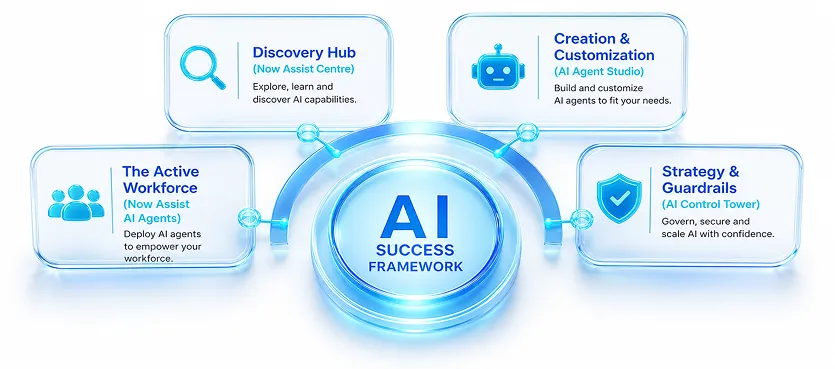
Here is how the core components fit together, tracing a line from initial discovery to live production governance:
- Phase 1: Discovery Hub (Now Assist Centre)
Think of the Now Assist Centre as the centralized control panel for all generative AI across your enterprise. This workspace is where administrators go to activate skills, review usage telemetry, and access system settings. AI Agent Advisor lives natively inside the Now Assist Centre. It sits at the very top of the operational lifecycle, feeding data-backed automation recommendations directly into the administrator’s primary dashboard. - Phase 2: Creation and Customization (AI Agent Studio)
When AI Agent Advisor discovers a high-frequency process that requires a custom solution, it generates a blueprint (including a suggested name, role, description, and execution steps). With a single click, this blueprint is pushed directly into AI Agent Studio. This is your low-code development environment. Here, engineers use natural language to fine-tune the agent, assign specific business boundaries, and plug in advanced protocols—like Model Context Protocol (MCP) servers—to grant the agent secure access to external tools and databases. - Phase 3: The Active Workforce (Now Assist AI Agents)
Once an agent is built in the Studio and verified using the Advisor’s automatically generated evaluation datasets, it is deployed into production as a live Now Assist AI Agent. These are your specialized digital workers. They operate autonomously within your workspace, responding to user prompts, triaging incoming cases, and executing complex workflows from start to finish. - Phase 4: Strategy and Guardrails (AI Control Tower)
Once your digital workforce is live, you need a way to manage them at scale. This is where the AI Control Tower steps in. The Control Tower acts as the executive dashboard for your entire AI footprint. It monitors the real-time performance of your active agents, tracks the overall business value they are generating, and enforces strict compliance guardrails (via Now Assist Guardian) to shield your enterprise from prompt injections or sensitive data leakage.
The Strategic Bottom Line
Without an AI Agent Advisor, scaling an autonomous workforce is a slow, trial-and-error process. By positioning the Advisor at the front of your deployment pipeline, you allow your own historical instance telemetry to dictate your automation map.
It takes care of the complex data clustering and ROI calculations in the background, leaving your platform teams free to focus on what matters most: configuring high-performing agents in AI Agent Studio, monitoring them through the AI Control Tower, and driving massive, measurable efficiency across the enterprise.