





Unifying Multi-Instance Architecture and AI Agents in ServiceNow HRSD
Modernizing human resources in global enterprises is no longer just about giving employees a pretty self-service portal; the ServiceNow Brazil release demonstrates that enterprise HR excellence requires balancing seamless, AI-driven front-end fulfillment with secure, multi-instance data architecture.
As C-suite executives, Platform Admins, and HR Transformation Leaders evaluate the latest platform capabilities, technical release notes can easily obscure the strategic realities of enterprise deployment. Rather than presenting a superficial list of new features, this post examines the structural alignment unfolding across HR Service Delivery (HRSD).Tracing how employee service delivery evolved from fragmented local ticketing systems to unified, multi-instance AI orchestration shows why the Brazil release marks a pivotal shift, and how enterprise leaders should navigate the transition.The Past: Fragmented Employee Support and Regional Data Silos
Historically, global enterprises struggled to deliver a unified HR experience. Operating across multiple subsidiaries, regions, or newly acquired business units often required running disparate, isolated ServiceNow instances or worse, fragmented legacy HR tools.
When employees needed support for cross-border transfers, global benefits inquiries, or international payroll updates, case context was lost during manual handoffs. Local HR teams operated in data silos to enforce regional compliance and data residency laws, forcing employees to navigate clunky, disjointed portals. AI assistance was non-existent, leaving fulfillment teams bogged down by manual case indexing and repetitive administrative tasks.The Pivot: Expanding Global Scope and Intelligent Assistance
As enterprise service management matured, the demand for cross-instance visibility grew alongside the need for automated fulfillment.
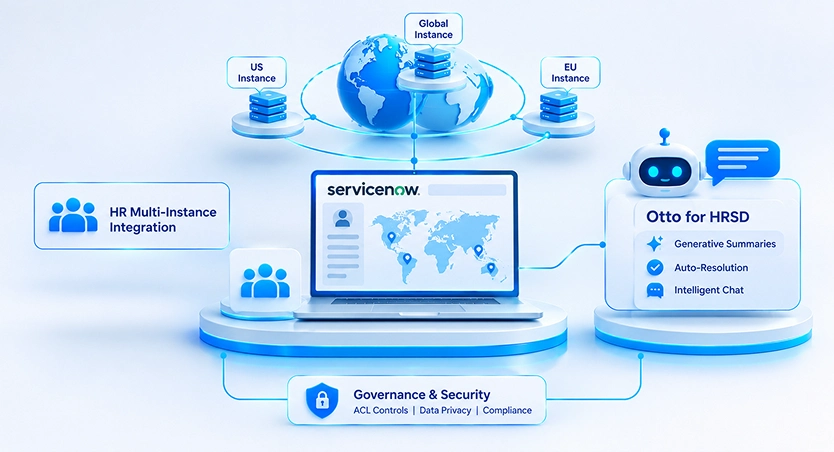
ServiceNow HR Multi-Instance Integration capabilities marked a major evolutionary step. By allowing a primary employee-facing instance to securely connect with regional or subsidiary sub-instances, ServiceNow enabled organizations to deliver a single entry point for global staff while maintaining local data boundaries and regional data residency compliance.Simultaneously, generative AI entered the HR ecosystem. ServiceNow Otto for HR Service Delivery (HRSD), virtual agent capabilities shifted from rigid, keyword-driven decision trees to contextual generative summaries, auto-generated case resolution notes, and intelligent chat contextualization.Establishing multi-instance integration while embedding contextual AI at the agent workspace level is foundational for enterprise scale. However, many deployment plans overlook the governance of prompt context across boundaries. Deploying generative summaries across multi-instance setups requires strict Access Control List (ACL) configurations and data privacy mapping to ensure AI models do not expose sensitive employee data across regional instance borders.The Present: Multi-Instance Harmony Meets Agentic AI Orchestration
The Brazil release brings multi-instance integration and AI intelligence together into a single, cohesive operational architecture.
HR Multi-Instance Integration release updates, multi-instance synchronizations now support enhanced mapping governance, automated payload processing, and tighter case lifecycle alignment between corporate instances and regional child instances. HR cases can be dynamically routed to local fulfillment teams while keeping high-level case metrics visible to global leadership.Concurrently, as outlined in the ServiceNow Otto for HRSD updates, the platform expands beyond simple text summarization into autonomous agentic workflows. AI agents can now actively generate step-by-step fulfillment plans, interact with Human Capital Management (HCM) backends, and automate tuition reimbursement or policy resolutions while keeping human agents appropriately in the loop.Unifying multi-instance case routing with agentic AI creates an exceptionally powerful service delivery model. However, attempting to activate autonomous AI workflows on top of an unharmonized multi-instance architecture creates severe operational friction. C-suite leaders must prioritize instance mapping hygiene and master data harmonization first. An AI agent cannot reliably generate a step-wise fulfillment plan if the underlying case data is fragmented across mismatched data models between parent and child instances.The Mechanics: Executing an Upgrade-Safe HR Architecture
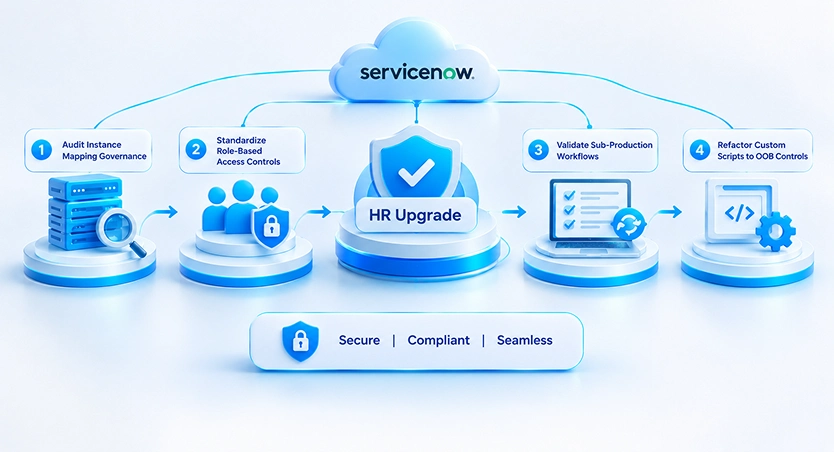
Optimizing global HR Service Delivery requires rigorous technical discipline during platform upgrades. TopTech recommends a structured four-step implementation roadmap:
- Audit Instance Mapping Governance: Review custom scripts, transform maps, and API endpoints across parent and child instances prior to initiating the Brazil release upgrade.
- Standardize Role-Based Access Controls: Verify that granular ACLs and role assignments are explicitly configured for Now Assist skills and AI agent workflows before enabling them in production.
- Validate Sub-Production Workflows: Execute comprehensive regression testing using Automated Test Framework (ATF) in Sandbox and Development environments to validate case state synchronization across multi-instance boundaries.
- Refactor Custom Scripts to OOB Controls: Convert custom JavaScript business rules handling cross-instance sync into out-of-the-box multi-instance configuration tables.Platform teams often allocate inadequate time for sub-production validation when dealing with HRSD integrations. Because HR data involves strict privacy controls, testing multi-instance payload delivery and AI summarization in sanitized non-production environments is essential to preventing data leakage or broken case routing during production cutover.
The Future: Zero-Friction Global Workforce Orchestration
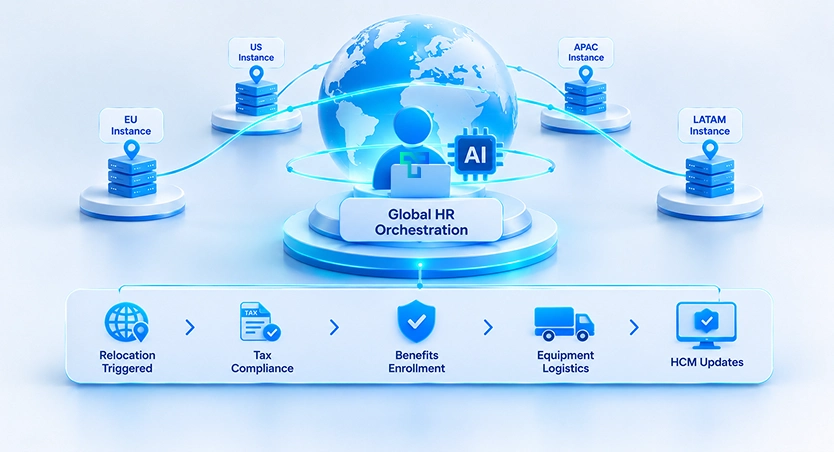
Looking ahead, the convergence of multi-instance data architecture and agentic AI will redefine the employee experience.
The future of HR Service Delivery is not just intelligent case handling—it is proactive, cross-border workforce orchestration. In upcoming platform cycles, an employee undergoing an international relocation will trigger an autonomous background agent that orchestrates tax compliance, local benefit enrollment, equipment logistics, and HCM system updates across multiple regional instances instantly, requiring zero manual handoffs between global HR teams.Establishing the architectural foundation for this zero-friction future starts by standardizing your multi-instance integration and AI governance in the Brazil release today.