





Why Your Shop Floor is the Missing Link in Customer Service and How ServiceNow Brazil Fixes It
Connecting the shop floor to the top floor is no longer just about gaining visibility; the ServiceNow Brazil release proves that modern manufacturing must actively bridge operational technology (OT) security with commercial workflows to build a resilient, unified enterprise.
As Platform Admins, CIOs, and manufacturing leaders evaluate the latest ServiceNow ecosystem upgrades, the sheer volume of documentation can easily obscure the strategic bigger picture. Rather than giving you a standard summary of patch notes, we are looking at the overarching narrative of the Brazil release.To make sense of where enterprise manufacturing is heading,Disconnected IT and the Black Box Shop Floor
Historically, enterprise IT stopped at the carpeted office. Customer service agents handled commercial disputes, IT managed server uptime, and the shop floor operated in a complete silo. Programmable logic controllers (PLCs), assembly line robotics, and industrial sensors were considered a black box, managed entirely by plant engineers with localized tools. When a machine failed, commercial operations didn't know until customer orders were already delayed, leading to reactive scrambling and frustrated clients.
Automating Industrial Routines
As organizations upgraded their instances, the push to digitize the shop floor gained massive momentum. The Combined Industrial Process Manager release notes for upgrades from Zurich to Brazil highlight how ServiceNow has formalized physical manufacturing routines. By bringing shop-floor processes directly into the platform, organizations can now standardize shift handovers, maintenance routines, and safety checks across multiple global sites by simply "requesting it from the ServiceNow Store".
Standardizing industrial processes on a single platform is a foundational necessity for scale. However, what is often missing from these technical upgrades is the human enablement factor. Deploying the Industrial Process Manager successfully requires designing mobile-first experiences for workers wearing gloves on a noisy factory floor. If the UI isn't built for their reality, adoption will flatline, regardless of how elegant the backend architecture is.Securing OT and Unifying Commercial Operations
The Brazil release represents a critical maturity milestone. According to the Operational Technology Release Notes, the platform is taking an aggressive stance on factory security. The updates to OT Discovery significantly "increases the visibility of OT devices" connected to your network, while deep integrations with vulnerability scanners like Claroty CTD allow security teams to take risk-based actions directly within the production process.
Simultaneously, the Manufacturing Commercial Operations (MCO) release notes showcase how these backend realities are being tethered to customer-facing outcomes. By updating core commercial workflows alongside industrial ones, ServiceNow ensures that order management, customer contracts, and dispute resolutions are informed by actual manufacturing capacity.This dual-pronged approach is brilliant, but things may go wrong for organizations that try to implement both simultaneously. Tying your commercial operations to your manufacturing data only works if your underlying OT data is secure and accurate. C-suite leaders must prioritize OT visibility and vulnerability management first. A compromised sensor on the shop floor can feed bad data straight to your customer service portals if you haven't locked down your OT environment.The Mechanics: Executing the Upgrades
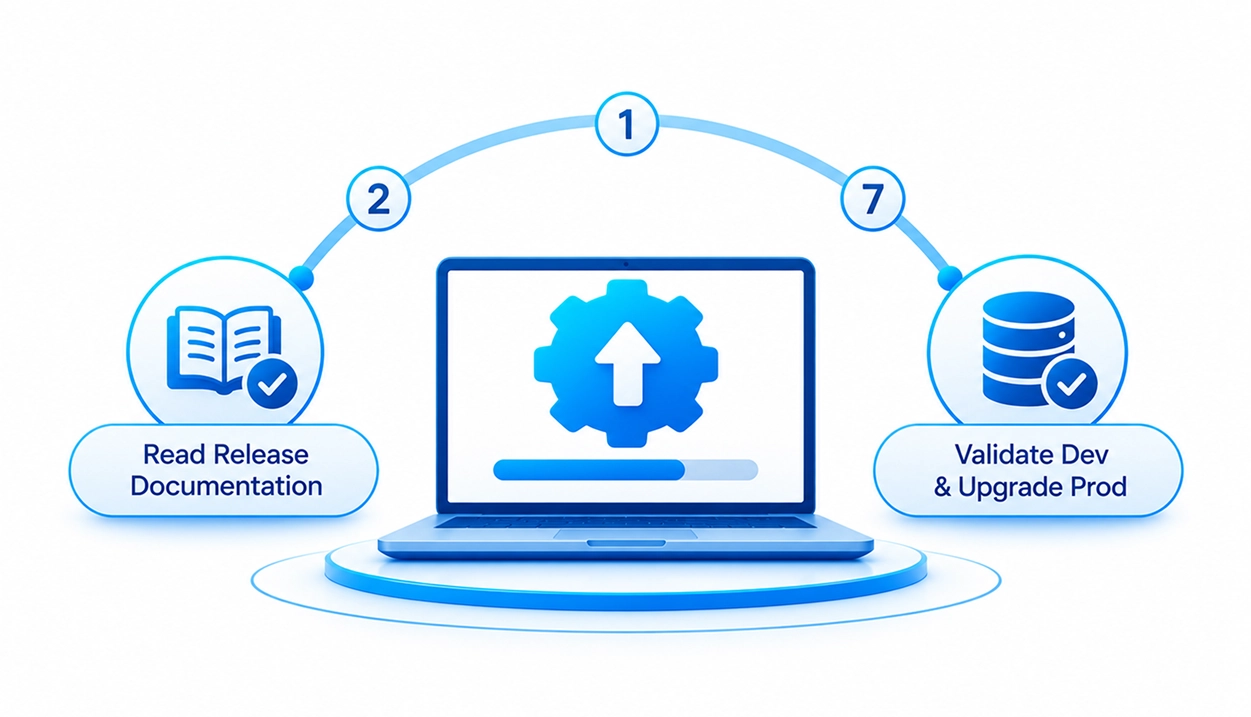
Navigating a major family release requires rigorous discipline. The ServiceNow Family Release Notes outline a strict seven-phase upgrade journey for the Brazil release, from reading the initial documentation through validating development instances and finally upgrading production. ServiceNow strongly advises platform teams to "complete the phases in the order listed" to mitigate risk.
While the phased framework is standard best practice, Platform Admins should spend 70% of their upgrade cycle in Phases 1 and 2. Rushing through the release notes and development instance prep usually results in broken custom integrations during the production push. For manufacturing environments where downtime costs thousands of dollars per minute, treat your development instance validation as a high-stakes dress rehearsal, not a checklist.The Dawn of Autonomous Industrial Orchestration
While the Brazil release does an excellent job of bridging IT, OT, and commercial operations, the actual endgame could be its autonomous orchestration.
Right now, MCO and OT are finally speaking the same language. Tomorrow, the expectation will shift from visibility to automated intervention. In the near future, an autonomous AI agent will detect an impending thermal failure on an OT asset, instantly pause the associated manufacturing run in the Industrial Process Manager, and proactively trigger a customer service update via MCO to adjust delivery timelines, all before a human operator even opens a dashboard. That is the true north for the resilient enterprise, and the architectural foundation for it is being laid right now.