








Are We Asking Too Much of Salesforce Admins? Rethinking the Modern CRM Role
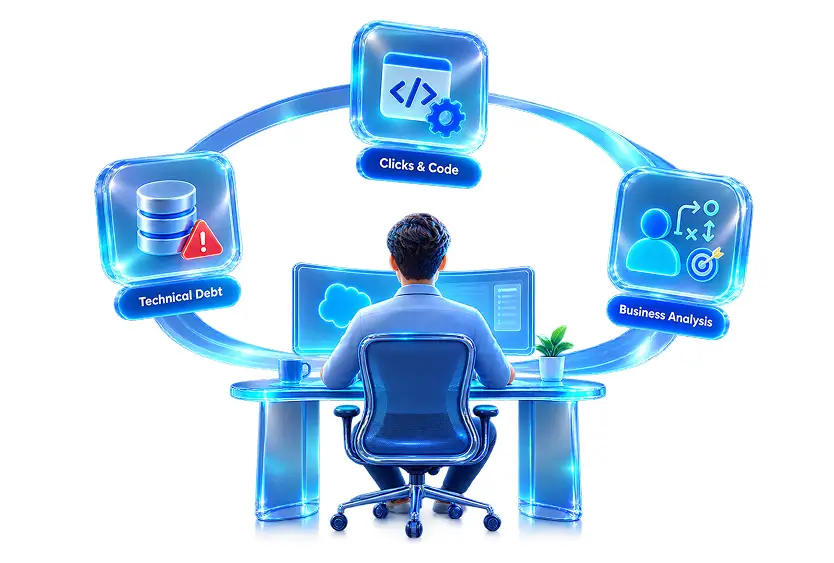
The role of the Salesforce Administrator was once defined by clear operational boundaries: configuring user profiles, generating reports, managing custom fields, and keeping data hygiene intact. Today, as enterprise tech stacks expand and low-code capabilities grow more sophisticated, we must candidly ask executive leaders across the ecosystem: are we asking too much of Salesforce admins? When a single role is expected to act as a platform architect, data analyst, change manager, and software developer simultaneously, team efficiency breaks down and platform debt accumulates. In this guide, we unpack the structural forces driving admin overload and outline actionable strategies to restructure responsibilities for long-term scalability.
Why Are We Asking Too Much of Salesforce Admins? The 3 Core Pressures
Over the past decade, the scope of a Salesforce instance has transformed from a single-cloud CRM into an enterprise-wide neural system. This expansion has altered what business leaders demand from their administrative personnel.
The Boundary Blur Between "Clicks" and "Code"
The evolution of visual automation tools, such as advanced Flow Builder frameworks, has empowered non-developers to create logic that rivals custom Apex code. While this lowers the barrier to building complex business logic, it also places enterprise-grade engineering responsibilities onto administrators. Admins are now managing complex execution paths, handling API integrations, and troubleshooting governor limits, tasks historically reserved for software engineers.The Compounding Weight of Legacy Technical Debt
Recent industry surveys show that over half of active Salesforce administrators consider technical debt to be their single greatest daily operational hurdle. Organizations rarely start with disorganized environments; rather, they accumulate layers of rushed updates, abandoned custom fields, and unmaintained legacy processes over years of business changes. When an admin inherits an un-documented environment, even simple field adjustments require extensive testing to avoid triggering unexpected downstream failures.Analogy: Expecting a single administrator to optimize a bloated, decade-old Salesforce instance is like asking a mechanic to tune an engine while the car is driving 70 mph down the highway. Without dedicated time for structural maintenance, minor repairs consume the entire workday.
Upstream Business Analysis Without Organizational Authority
Modern administrators are no longer just ticket solvers; they are frequently thrust into strategic business analyst roles. They are asked to translate ambiguous departmental requests into platform architecture, negotiate competing priorities between Sales and Marketing, and train end-users. Yet, despite this expanded operational mandate, many admins lack the formal authority or dedicated headcount to enforce proper intake governance.The Hidden Costs of Administrator Overload

When companies treat the admin role as an all-encompassing catch-all for anything platform-related, the operational impact reaches well beyond the IT department.
Increased Platform Risk and Unplanned Downtime
When administrators are rushed to deliver constant "quick fixes" without structured release management or sandbox testing, the likelihood of production errors escalates. A single misconfigured validation rule or conflicting automation can lock out sales teams or disrupt customer-facing portals, directly affecting revenue.Talent Turnover and Ecosystem Retention Challenges
Survey data across the Salesforce community indicates that over 50% of administrators feel overloaded by job expectations, leading a growing proportion to consider transitioning into specialized developer or consulting roles. Replacing a seasoned admin who holds deep domain knowledge of an organization's custom setup is both costly and disruptive.Strategic Frameworks to Protect and Empower Admins
To build a sustainable platform operations model, leadership must move away from the "solo admin" paradigm and establish structured support systems.
Implement Formal Request Intake Governance
Eliminate informal request channels such as direct messaging or verbal requests. Establish a single ticketing intake system where every business request must include a defined business objective, impact assessment, and clear priority tier before entering the build queue.Decouple Business Analysis from System Administration
Recognize that gathering requirements is a distinct skill set from platform configuration. As an organization scales beyond 100 Salesforce users, split responsibilities between a Business Analyst (who owns stakeholder engagement and workflow design) and a Salesforce Administrator (who owns platform security, data hygiene, and system health).Dedicate 20% of Capacity to Technical Debt Remediation
Just as engineering teams run technical maintenance sprints, administrative teams need dedicated time to audit unused fields, consolidate record-triggered flows, and archive legacy reports. Allocating one out of every five working weeks to platform cleanup prevents technical debt from snowballing.Modernize Release Management with DevOps Practices
Move away from manual change sets and direct production edits. Equipping administrators with modern release management and version control tools ensures that changes are tested systematically in sandboxes before deployment, minimizing operational risk.Key Takeaways
- Acknowledge expanding complexity: The shift toward advanced low-code automation and multi-cloud integrations has significantly expanded the skill set required of administrators.
- Address technical debt proactively: Unchecked system clutter is the leading driver of admin stress and platform instability; schedule regular cleanup capacity.
- Establish intake governance: Protect admin capacity by requiring formal business cases and prioritized ticketing for all configuration changes.
- Separate role lanes as you scale: Divide business analysis, administrative maintenance, and technical development into distinct functions as user count grows.
Conclusion: Restoring Balance to Platform Operations
When we evaluate whether we are asking too much of Salesforce admins, the evidence highlights a clear need for structural change. Administrators remain the vital backbone of successful Salesforce implementations, but expecting a single role to carry business analysis, system architecture, security compliance, and user support is no longer viable. By establishing clear governance, separating functional roles, and committing to ongoing technical debt reduction, leadership can foster a resilient, scalable platform ecosystem.
Ready to evaluate your platform governance and support structure? Contact our strategy team today to explore tailored Center of Excellence and admin enablement frameworks.