








ServiceNow vs Jira Service Management: Which Fits Your IT Team?
Selecting the right IT Service Management (ITSM) solution is one of the most critical decisions a technology leader makes. The debate around ServiceNow vs Jira Service Management usually centers on two distinct operational philosophies: an enterprise-grade platform built to unify complex cross-departmental workflows versus a lightweight, Agile-centric service desk tightly coupled with developer pipelines. At TopTech, we analyze these platform dynamics to help IT executives choose the system that aligns with their operational scale, budget, and engineering culture.
In this guide, we break down how both platforms handle core ITIL processes, support developer velocity, scale across the enterprise, and adapt to modern autonomous workflows.Architectural Philosophies: Enterprise Engine vs. Agile Service Desk
To understand which platform fits your organization, you must look beyond surface features at its underlying architectural intent.
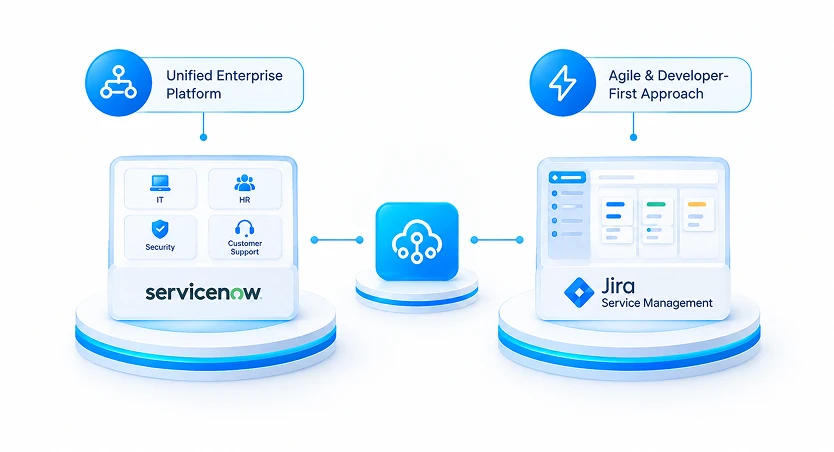
ServiceNow was designed from the ground up as a single, unified enterprise platform—the Now Platform. It acts as an operational system of record, connecting IT, HR, Security, and Customer Support through shared data models and native workflow orchestration. Its goal is total end-to-end governance and multi-departmental service delivery.Jira Service Management (JSM), built on Atlassian's core Jira framework, approaches IT service from a developer-first perspective. It excels at breaking down silos between software engineering teams and IT operations support, using an Agile-friendly interface that feels familiar to software developers already working in Jira.Core Philosophy Snapshot:
- ServiceNow: Built for comprehensive enterprise workflow automation, strict ITIL governance, deep CMDB relationships, and unified cross-enterprise service management.
- Jira Service Management: Built for rapid deployment, developer-IT Operations collaboration (DevOps), Agile responsiveness, and cost-effective ticketing.
Direct Comparison: How They Handle Core IT Operations
While both solutions handle routine tickets and change requests, their execution paths cater to different organizational needs.
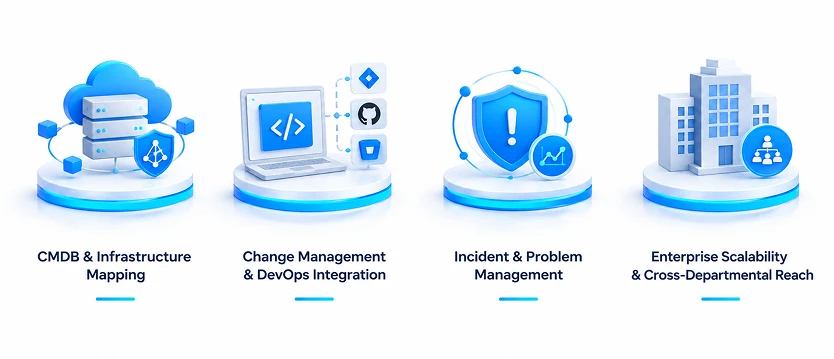
- CMDB and Infrastructure Mapping: ServiceNow offers an industry-leading Configuration Management Database (CMDB) capable of automated service mapping across hybrid cloud environments. It tracks complex dependencies, ensuring change managers understand exact infrastructure risks before deploying code. JSM’s Assets feature provides flexible asset and configuration tracking, ideal for mid-sized setups or modular asset management, though it requires more deliberate configuration to match enterprise dependency mapping.
- Change Management and DevOps Integration: JSM provides seamless native integration with Jira Software, Bitbucket, and GitHub. Developer pull requests can automatically create, evaluate, and approve low-risk change tickets in seconds. ServiceNow delivers robust automated change gates as well, backed by deep policy checks and risk scoring, making it ideal for heavily regulated environments.
- Incident and Problem Management: ServiceNow excels at correlation using predictive intelligence and AI agents to group related incidents, identify root causes, and trigger automated remediation. JSM streamlines incident triage through fast user interfaces, intuitive team routing, and tight integration with incident response tools like Opsgenie.
- Enterprise Scalability and Cross-Departmental Reach: Extending beyond IT into HR Service Delivery, Security Operations, and Legal workflows is seamless on ServiceNow due to its common data model. JSM can expand into non-IT business projects, but managing hyper-complex cross-departmental workflows often requires adding apps from the Atlassian Marketplace.
Evaluating Total Cost of Ownership and Time-to-Value
Financial considerations extend far beyond initial software license quotes. Enterprise buyers must factor in implementation effort, ongoing administration, and ecosystem add-ons.
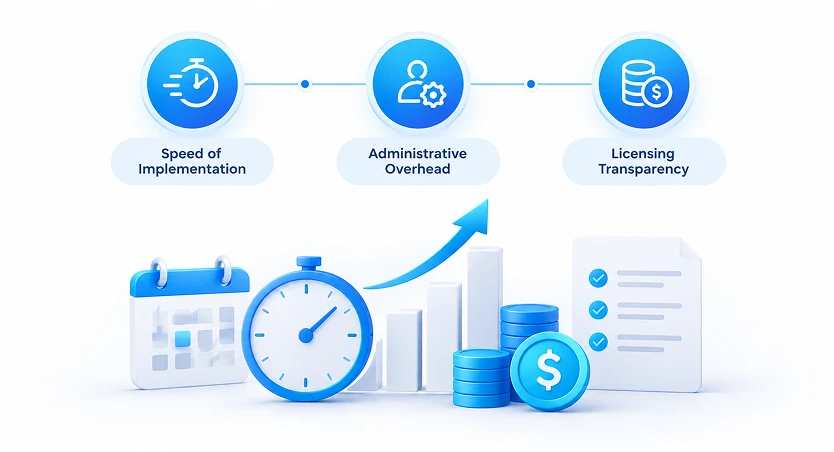
- Speed of Implementation: Jira Service Management generally offers a much faster time-to-value. Mid-market teams can deploy functional service desks in weeks using out-of-the-box templates without hiring specialized external consultants. ServiceNow implementations, due to their broad enterprise scope and deep customization capabilities, typically involve structured multi-month rollout phases led by certified implementation partners.
- Administrative Overhead: Maintaining a large ServiceNow instance usually requires dedicated platform administrators, developers, and process owners. This investment pays dividends through tailored automation and enterprise governance. JSM requires less administrative overhead, allowing existing Jira admins to manage the service desk alongside software projects.
- Licensing Transparency: JSM operates on a straightforward per-agent pricing structure with transparent public tiers, making budget forecasting predictable for growing teams. ServiceNow tailors custom enterprise contracts based on fulfiller seats, module tiers (Foundation, Advanced, Prime), and consumption units offering massive economies of scale for large global workforces.
Decision Matrix: Which Platform Fits Your IT Team?
Choosing between ServiceNow vs Jira Service Management ultimately comes down to your organization's operational maturity, team structure, and strategic vision.
Choose Jira Service Management if your team:
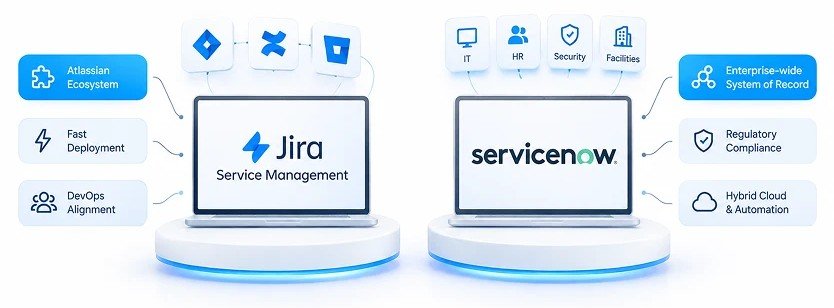
- Operates heavily within the Atlassian ecosystem (Jira Software, Confluence, Bitbucket).
- Prioritizes fast deployment, intuitive user interfaces, and minimal administrative overhead.
- Needs to bridge the gap between software developers and IT operations (DevOps alignment).
- Wants a cost-effective, scalable solution without high initial implementation investments.
Choose ServiceNow if your organization:
- Requires a comprehensive, enterprise-wide system of record across IT, HR, Security, and Facilities.
- Operates under strict regulatory frameworks requiring advanced ITIL alignment, policy enforcement, and auditability.
- Manages massive, complex hybrid cloud infrastructures with multi-layered dependency mapping.
- Plans to deploy advanced autonomous AI specialists and automated enterprise orchestration at scale.
Key Takeaways for You to Make the Decision Best for Your Enterprise
- Distinct Operational Focus: The choice between ServiceNow vs Jira Service Management balances ServiceNow's enterprise governance against JSM's developer-aligned speed.
- Architecture & Scope: ServiceNow delivers an end-to-end enterprise platform with a deep CMDB, while JSM provides an Agile-friendly service desk deeply integrated into developer pipelines.
- Time-to-Value vs. Scale: JSM deploys rapidly with lower administrative demands, whereas ServiceNow requires larger implementation efforts that yield massive long-term scale.
- Strategic Alignment: Match your choice to your engineering culture: select JSM for developer-heavy, fast-moving teams; select ServiceNow for broad enterprise transformation and strict compliance.
Optimize Your IT Service Strategy with TopTech
Whether you are scaling an Agile IT service desk or architecting a multi-departmental enterprise platform, choosing and configuring the right ITSM architecture requires deep industry experience. At TopTech, our senior technology leads and certified platform architects help enterprise organizations evaluate software ecosystems, streamline migrations, and build high-performing service management workflows.
Ready to find the ideal ITSM fit for your organization? Contact our platform specialists today to schedule a detailed architecture and workflow evaluation.