







AI Agents Challenge Traditional Per-User Licensing Models Across Enterprise Software
For decades, Software-as-a-Service (SaaS) growth relied on a simple equation: more human employees meant more software seats purchased. Today, as autonomous digital workforces execute complex workflows without human intervention, AI agents challenge traditional per-user licensing models at their structural core.
At TopTech, we analyze how this seismic shift forces enterprise leaders and platform giants like ServiceNow to rethink monetization, seat counts, and digital ROI.Why Autonomous AI Breaks the Per-Seat Pricing Paradox
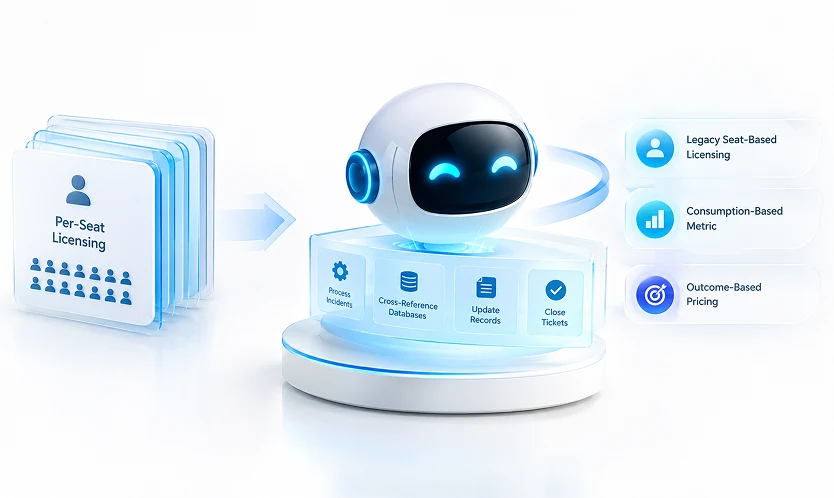
Legacy software licensing operates on headcount. If your enterprise hires 500 IT service agents, you buy 500 licenses for your service management platform. However, autonomous agents do not fit neatly into human headcount metrics. A single AI agent can process thousands of incidents overnight, cross-reference databases, update records, and close tickets without ever logging into a physical workstation.
When software vendors price their products exclusively per human seat, automating work actually threatens vendor revenue. If 20 digital agents eliminate the need for 50 human seats, a strict per-user pricing structure penalizes the vendor for delivering extreme operational efficiency. Consequently, the industry is racing toward outcome-driven and consumption-based metrics.Comparing Enterprise Monetization Models
- Legacy Seat-Based Licensing: Revenue tied strictly to active human logins, penalizing operational efficiency and workforce automation.
- Consumption-Based Metric: Pricing tied to API calls, compute volume, or transactional throughput across platform layers.
- Outcome-Based Pricing: Costs linked directly to completed business tasks, such as resolved incidents or automated approvals.
Strategic Shift: How AI Agents Disrupt Software Economics

As autonomous systems mature across the ServiceNow ecosystem, enterprise financial models must adapt across three critical operational layers.
3 Pillars of the Post-Seat Enterprise Pricing Era
As AI agents challenge traditional per-user licensing models, enterprise architecture and procurement teams must evaluate how platforms measure, bill, and scale software value.
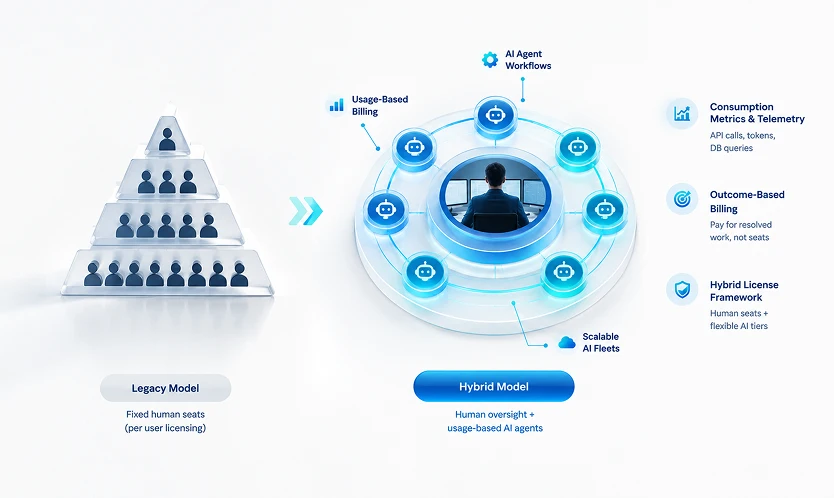
- Consumption Metrics & Transaction Telemetry: Shift focus from counting active user accounts to tracking API requests, workflow execution tokens, and database calls.
- Outcome-Based Billing Structures: Transition toward paying for completed platform actions, such as automated password resets, ticket triage, or vendor onboarding cycles.
- Hybrid License Frameworks: Combine foundational platform access seats for human supervisors with flexible usage tiers for autonomous AI agent fleets.
The Rise of Consumption Telemetry
Instead of buying a flat seat for every worker, enterprise contracts increasingly feature baseline platform access paired with flexible usage pools. Platforms meter operational activity using standardized compute or transaction metrics. This setup ensures that high-volume digital automation pays for the compute power it consumes without requiring artificial human accounts.Measuring Value by Resolved Work
Outcome-based monetization creates direct alignment between enterprise buyers and platform providers. When costs are tied to successful task resolutions rather than user seats, companies only pay when the AI agent delivers tangible business value. This removes the financial penalty historically associated with automating internal service desks.Architecting Hybrid Governance Models
Human workers and autonomous digital workers require different access privileges and licensing structures. A hybrid licensing approach ensures human enterprise users retain proper governance oversight while autonomous AI agent fleets operate within scalable, usage-based boundaries.Design Note for Graphics Team: Create a clean visual diagram illustrating the transition from a rigid human seat pyramid (legacy) to a flexible hybrid wheel where human operators sit at the center surrounded by expanding, usage-billed AI agent workflows.Navigating ServiceNow Licensing for Autonomous Workflows
ServiceNow remains at the forefront of this business model shift. As enterprise customers deploy generative AI and autonomous workflows across IT Service Management (ITSM) and Customer Service Management (CSM), licensing strategy requires careful evaluation.
- Aligning Now Assist with Value: ServiceNow's generative AI capability, Now Assist, introduces capacity-based consumption tokens alongside traditional user tiers. This allows enterprise teams to scale automated incident summarization and resolution without purchasing additional full-user licenses for digital workers.
- Partnership Ecosystem Pressures: Software vendors and channel partners must reshape their revenue expectations. Because value is no longer measured purely by seat expansion, implementation partners must focus on delivery speed, integration quality, and workflow optimization.
4 Action Items for Enterprise Procurement Leaders
At TopTech, we advise IT executives and procurement leads to update their software asset management strategies immediately using these four guidelines:
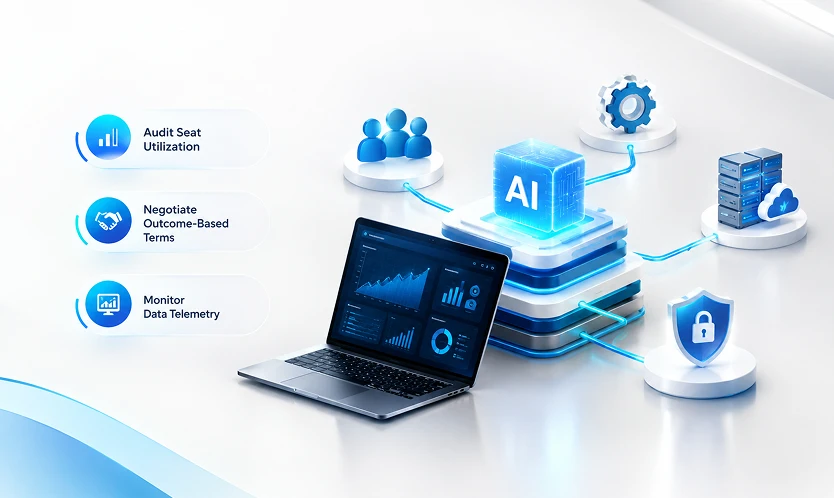
- Audit Seat Utilization Against Automation Targets: Identify departments where active human seat counts will contract as autonomous AI agent adoption increases over the next fiscal cycle.
- Negotiate Outcome-Based Terms: Push vendors for consumption-based hybrid models that charge based on completed transactions rather than imposing legacy seat penalties.
- Establish Data Telemetry Monitoring: Implement internal tracking for API calls, workflow executions, and AI token consumption to prevent unexpected bill shocks.
- Decouple Identity Management from Billing: Ensure your enterprise identity access provider (IAM) distinguishes between human seats and autonomous digital service accounts to avoid unnecessary software seat allocations.
Key Takeaways
- Structural Disruption: As AI agents challenge traditional per-user licensing models, software vendors must abandon strict seat counts to avoid penalizing automation.
- Value-Driven Monetization: Enterprise software pricing is rapidly moving toward consumption metrics (tokens, API calls) and outcome-based billing (completed tasks).
- ServiceNow Ecosystem Adaptation: Solutions like Now Assist leverage hybrid usage models to ensure companies can deploy digital workforces efficiently.
- Procurement Shift: IT asset managers must transition from counting human user logins to tracking workload units, transaction volumes, and automated task execution.
Strategic Platform Optimization with TopTech
Navigating the shift from legacy software seats to AI-driven consumption models requires technical architecture, licensing foresight, and workflow governance. At TopTech, our senior platform architects assist enterprise leaders in optimizing ServiceNow architectures, streamlining integrations, and maximizing software ROI.
Ready to modernize your enterprise software strategy? Contact our platform specialists today to schedule a comprehensive licensing and architecture audit.