







Salesforce Agentic Enterprise Index: What Real-World AI Adoption Means for Your Enterprise

The era of simple AI chatbots and passive text-generation assistants is fading. Enterprise organizations are shifting toward autonomous digital workforces capable of taking real-world actions, executing multi-step business logic, and resolving complex customer workflows independently. At TopTech, we treat the release of the Salesforce Agentic Enterprise Index as a crucial reality check for modern IT strategy.
This index moves beyond vendor promises, offering empirical telemetry on how businesses deploy, scale, and trust AI agents across their core revenue architectures.What Is the Salesforce Agentic Enterprise Index?
The Salesforce Agentic Enterprise Index is an empirical research and telemetry report tracking production AI agent adoption across thousands of global organizations running the Agentforce platform. Rather than surveying subjective sentiments alone, the index aggregates active usage metrics across five full quarters, qualifying only enterprises that maintain active, production-grade agents month over month.
The primary takeaway is unmistakable: companies are rapidly evolving from experimental proof-of-concept AI trials to scaling operational agent fleets.Legacy Chatbots vs. Agentic Infrastructure
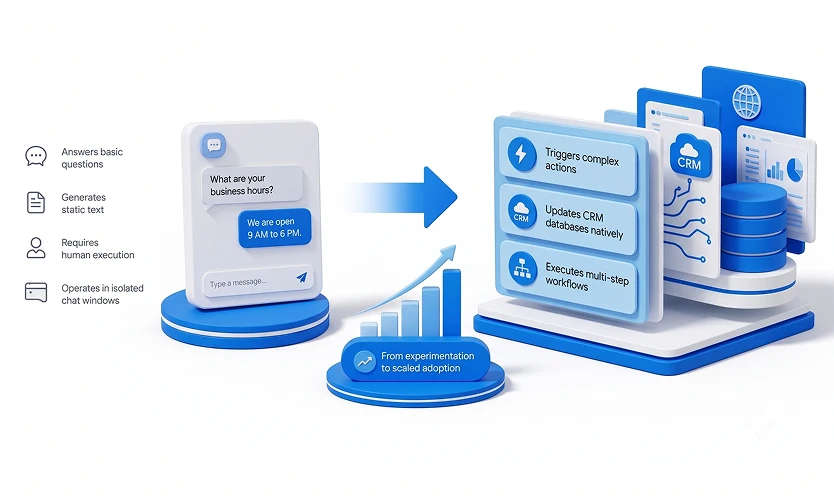
- Legacy Conversational AI: Answers basic questions, generates static text, requires human execution, and operates inside isolated chat windows.
- Agentic AI Infrastructure: Triggers complex backend actions, updates CRM databases natively, executes multi-step workflows, and operates across unified enterprise data.
4 Core Telemetry Metrics from the Agentic Enterprise Index
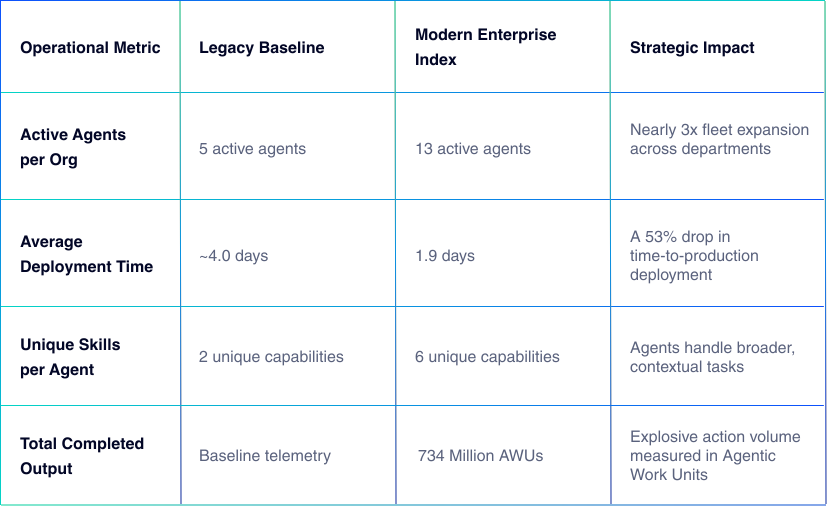
The latest index data provides four clear operational metrics that highlight how autonomous AI is maturing across enterprise environments.
3 Strategic Drivers Shaping the Agentic Enterprise Shift

Scaling an autonomous digital workforce requires moving past basic prompt engineering. Insights from the Salesforce Agentic Enterprise Index reveal three architectural foundation pillars driving successful deployments.
- Radically Reduced Deployment Windows: Low-code, declarative frameworks allow enterprise teams to build, test, and launch targeted agents in under two days.
- Expansion to Multi-Skill Execution: Agents evolve from single-field edits to evaluating policies, cross-referencing account histories, and executing cross-system workflows.
- Shift to Action-to-Output Metrics: Evaluation shifts from conversation length to completed business tasks measured via Agentic Work Units.
Radically Reduced Deployment Windows
Building and deploying an operational AI agent no longer demands months of custom software development. With deployment timelines dropping to just 1.9 days on average, enterprise teams can quickly configure, test, and release targeted agents using declarative flows and pre-built skill templates.Multi-Skill Execution Capabilities
Early AI bots performed isolated, single-turn commands. Telemetry shows agents tripling their native skill sets, expanding from simple record updates to cross-referencing account histories, evaluating business policies, and issuing outbound transactions within a single transaction pipeline.Focus on Output-Based Business Outcomes
The index introduces a key distinction: measuring execution rather than raw conversation volume. Through Agentic Work Units (AWUs), enterprise leadership can evaluate AI performance based on completed end-to-end tasks, such as resolving a billing dispute or updating pipeline stages, rather than simple chat response rates.Industry Patterns: High-Volume Velocity vs. Complex Governance
The Salesforce Agentic Enterprise Index demonstrates that different sectors take distinct paths toward agentic adoption.
- Consumer-Facing Sectors (Retail & Travel): Prioritize raw transaction scale and rapid response times. Retail organizations alone accounted for a massive portion of total monthly Agentic Work Unit outputs, leveraging agents to handle extreme volume spikes during peak demand periods. Surveys show a vast majority of shoppers report higher purchase confidence when interacting with trained brand agents.
- Regulated Sectors (Financial Services & Healthcare): Deploy smaller, highly specialized agent fleets focused on data compliance, automated case auditing, and policy checks. Here, precision and strict governance outweigh pure message volume.
Blueprint: 4 Steps to Scale Your AI Agent Fleet Responsibly
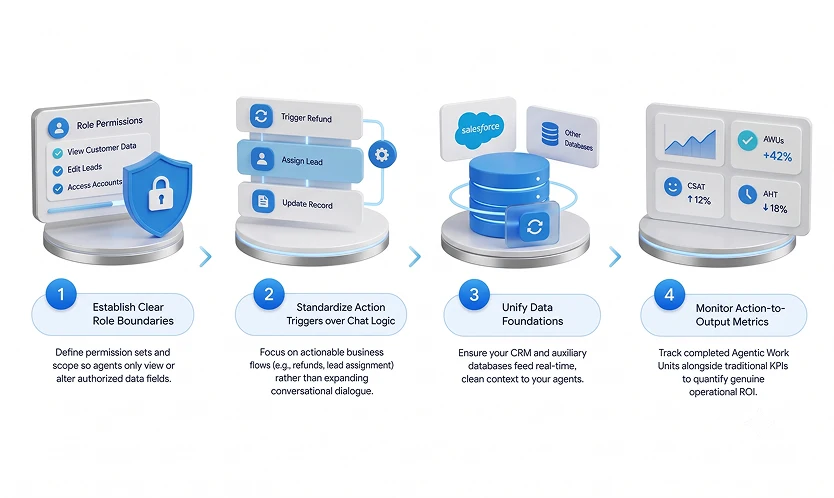
Deploying autonomous agents without clear boundaries creates operational risks. At TopTech, we recommend a phased approach grounded in index findings:
- Establish Clear Role Boundaries: Treat agents like new team members. Define explicit permission sets and scope to ensure agents only view or alter authorized data fields.
- Standardize Action Triggers over Chat Logic: Focus your team's build efforts on equipping agents with actionable business flows (e.g., triggering refunds, assigning leads) rather than expanding conversational dialogue.
- Unify Data Foundations: Ensure your CRM and auxiliary databases feed real-time, clean context to your agents. An agent operating on stale customer data will execute incorrect operational actions.
- Monitor Action-to-Output Metrics: Track completed Agentic Work Units alongside traditional KPIs (such as Customer Satisfaction Score or Average Handling Time) to quantify genuine operational ROI.
Key Takeaways
- Production Over Pilots: The Salesforce Agentic Enterprise Index confirms that companies are scaling active agent fleets, growing from an average of 5 to 13 active production agents per enterprise.
- Faster Time-to-Value: Deployment timelines fell by 53% to 1.9 days on average, allowing IT teams to iterate and launch new agent skills rapidly.
- Action-Oriented Metric Focus: Enterprise success is measured by executed tasks and Agentic Work Units (AWUs), not conversational chat length.
- Tailored Industry Deployment: Retail focuses on high-volume scale, while regulated industries leverage smaller, highly specialized agent fleets for targeted workflows.
Drive Your AI Transformation with TopTech
Transitioning from simple generative AI prompts to a fully orchestrated agentic workforce demands modern platform architecture and tight operational governance. At TopTech, our Salesforce architects help enterprise organizations design, deploy, and scale autonomous digital workforces that drive measurable ROI.
Ready to scale your enterprise agent strategy? Contact our platform leads today to schedule a detailed AI architecture assessment.