








Small Team, Powerful CRM: Making Salesforce Work Without an Enterprise Budget
There is a common misconception in the business world that Salesforce is exclusively built for Fortune 500 corporations with massive IT budgets and dedicated developer teams. However, running Salesforce without an enterprise budget is not only possible, it is one of the most effective ways for lean organizations to accelerate revenue growth. When growing teams strip away unnecessary customization and focus on core operational workflows, Salesforce transforms into an agile, cost-effective growth engine. In this guide, we break down how small teams can maximize their CRM ROI, eliminate implementation bloat, and build a high-impact setup using native capabilities.
Rethinking CRM Adoption: Why Lean Teams Have an Advantage
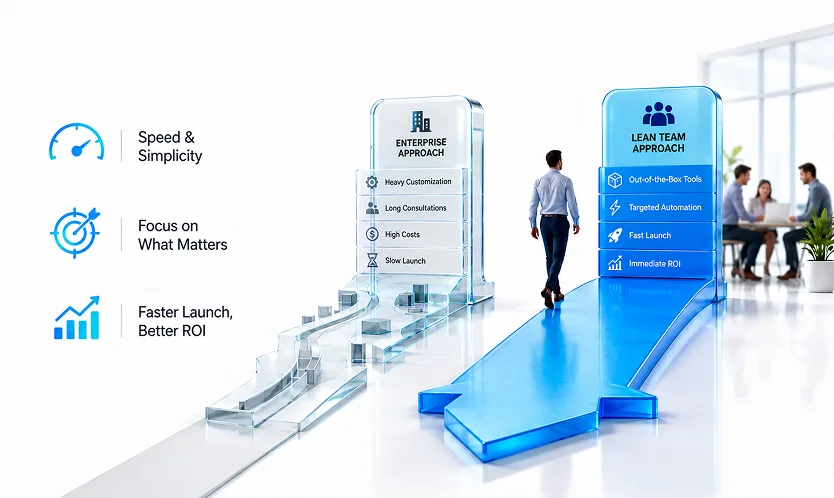
Large enterprises often struggle with CRM adoption due to bureaucratic decision-making, legacy technical debt, and multi-departmental friction. Smaller teams, by contrast, possess an inherent strategic advantage: speed and simplicity.
The Trap of Over-Engineering Day One
The most frequent mistake small teams make is attempting to replicate complex enterprise setups on day one. By creating dozens of custom objects, intricate validation rules, and heavy code configurations before mastering baseline lead management, lean orgs inflate implementation costs and confuse end-users.Value-First Implementation
A lean CRM strategy focuses entirely on immediate business outcomes. By prioritizing core sales activities, such as lead tracking, opportunity pipeline visibility, and automated email logging, small teams can achieve full platform adoption within weeks rather than months.Analogy: Setting up Salesforce for a small team is like buying a high-performance sports car. You do not need to overhaul the engine or re-engineer the transmission before taking it out of the showroom; you simply need to turn the key, adjust the mirrors, and drive.
4 Strategies to Maximize Salesforce Value on a Budget

Maximizing platform capability while keeping operational costs low requires leveraging out-of-the-box functionality, native automation, and pre-built solutions.
Start with Out-of-the-Box Suites
Tailored editions like Salesforce Starter and Pro Suite provide lean teams with pre-configured sales, service, and marketing tools right out of the box. These solutions eliminate the need for extensive initial consulting contracts, allowing small teams to manage leads, track deals, and send customer emails from a single, unified environment immediately.Automate Repetitive Tasks with Flow Builder
You do not need a team of software developers to eliminate manual data entry. Using native, clicks-not-code tools like Flow Builder, small teams can automate high-value operational tasks without custom code:- Automatically assign incoming web leads to reps based on region.
- Trigger follow-up tasks when an Opportunity reaches a specific stage.
- Notify account managers in real time when a customer contract approaches renewal.
Plug-and-Play with Free AppExchange Tools
Before investing tens of thousands of dollars in custom software integrations, explore the Salesforce AppExchange. The ecosystem offers hundreds of free, pre-built components, dashboards, and connectors created directly by Salesforce and trusted partners. Whether you need electronic signature collection, document generation, or basic marketing analytics, pre-packaged apps drastically reduce development overhead.Standardize Data Hygiene Early
Data cleanup is far cheaper when an org is small. By establishing basic validation rules, enforcing mandatory email fields, and running periodic deduplication jobs from the start, lean teams ensure their analytics remain accurate without needing expensive data-cleansing projects down the road.A Phased Growth Roadmap for Growing Orgs

Scaling your CRM environment successfully means expanding functionality in step with business growth rather than paying for features before you need them.
- Phase 1 (Foundation): Standardize standard Lead, Account, Contact, and Opportunity objects. Establish clear pipeline stages and train reps on daily usage.
- Phase 2 (Automation): Implement native Flow Builder automations to handle task creation, email alerts, and lead assignment.
- Phase 3 (Integration): Connect your email calendar (Outlook or Gmail) and core communication channels to log customer interactions automatically.
- Phase 4 (Optimization): Introduce custom reporting dashboards, refine forecasting models, and explore advanced analytics as revenue increases.
Key Takeaways
- Embrace out-of-the-box solutions: Use pre-configured editions like Starter or Pro Suite to launch quickly without heavy consulting fees.
- Prioritize value over complexity: Focus initial efforts on core pipeline tracking and lead management before building custom objects.
- Leverage native automation: Use low-code tools like Flow Builder to eliminate manual data entry without writing custom code.
- Utilize the AppExchange: Tap into free, pre-built apps and connectors to extend platform capabilities affordably.
- Scale in phases: Expand system capabilities gradually as revenue grows and operational needs evolve.
Conclusion: Unlocking Enterprise Power for Growing Teams
Running Salesforce without an enterprise budget is ultimately about strategic focus, not compromise. By embracing out-of-the-box capabilities, automating routine tasks with low-code tools, and scaling thoughtfully, small teams can deploy a world-class CRM that drives real revenue growth without breaking the bank.
Ready to optimize your CRM strategy and build an agile growth platform? [Contact our SMB implementation experts today] to discover how we can help you maximize your Salesforce return on investment.